Not long ago I was in a yoga class where the teacher asked my classmates and I what we preferred to work on, upper body/arms or hips.
As the Yoga Hub is an intimate studio and tends to have a good gender balance in class, it was very clear who chose arms (men) and who chose hips (women).
Not only were we playing to gender stereotypes of man strong & woman emotional – it is said that we humans hold our emotions in our hips – we were playing to what was ‘easy’ for us.
Sometimes the path of least resistance is the best path for you on a particular day. At times I struggle in class for whatever reason physically and/or mentally and the moment I go into a hip-based asana I reach nirvana.
Yoga is a practice. You don’t have to be perfect every time. You don’t even have to be
perfect one time. It is your practice and ultimately you decide how strong you want to make it.
However, some days you should take the uphill path.
You’re wrecked. Your shoulders/hips are tight because you got into a disagreement with your boss/lover/parent/child/coffee barista – whatever – you’re lucky you even made it to the mat and now after a few sun salutations you’re being asked to go into an asana that challenges you.
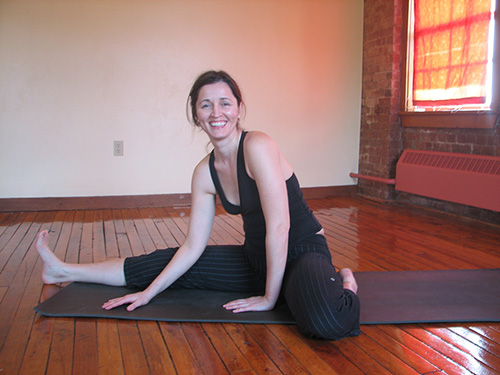
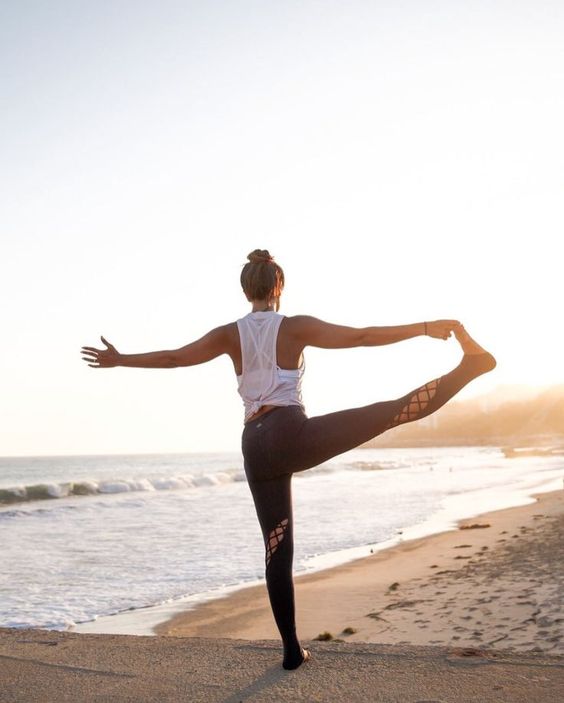
You can take child’s pose – it’s always an option – or you can do THIS.
You may not perfect the asana at that moment, but you’ll be a step closer and you didn’t give in. Both of these things are major achievements.
And if you get there the satisfaction you gain is worth 1000 moments of nirvana in an asana that’s easy for you.
P.S. The rainbow of nail polish on our toes at practice is lovely, but to help save Mary’s walls becoming yoga’s version of the Berlin Wall use a top coat on your toes. I usually use a top coat, but didn’t recently and noticed that I…ummm…may have left a bit of graffiti behind when doing the standing splits. (Sorry Matt!)
Second Blog so kindly shared by Marie McPeak. Open hearted and insightful as ever. Thank you, Thank you, Thank you Marie. Follow Marie on twitter @marielmcp

If you would like to share your experience
of Yoga, a class you attended or a workshop, a vegetarian or vegan recipe or anything else of interest just send it to info@theyogahub.ie and it will be done:-)
Eureka moments come when you least expect them. I was having a hopeless moment in 
Ardha Chandrasana (Half-Moon Pose). In these hopeless moments I am usually thinking any and/or all of the following:
“Am I doing this right? I am definitely not doing this right.” “Why doesn’t the teacher correct me or tell me I am doing it right?”
“I’m hopeless and they could spend the whole class correcting me and I still won’t get it right.”
“Why the f*** am I doing yoga anyhow? “
I was looking for reassurance or even praise regarding my practice from an
external source. This is a common theme in my life. I have a tendency to think the worst if I am not told by someone else that I am amazing 24/7. All of that competing for and obtaining gold stars in school created a praise hungry woman.
Then I just stopped. Inhale. Exhale. Squared my hips a bit more and EUREKA – I was in it. It being the pose, the moment and a major realisation.
I should listen to my body and my breath, trusting what they tell me. I must know that sometimes balance isn’t immediate or that my hips want to twist in that moment and that it’s okay to start over.
Most of all I need to be present in that moment. It is good to be aware your teacher will adjust you when necessary – sometimes we all need a little help, but that your practice is your own and you set your limits.

That moment was small, but mighty, creating an awareness of the limits I was placing on myself through the belief that the only valid praise came from outside of myself – that realisation had more worth than any gold star ever could.
Marie’s first Blog for the Yoga Hub (The first of many we hope). Thanks so much for sharing your personal experience Marie. I’m sure anyone reading can relate.

arts in northern India since childhood. From the age of 8, he studied Vedic wisdom at Kanvashram in the foothills of the Himalayas. With its historic temple and Ayurvedic clinic, Kanvashram attracts many yogic saints and Ayurvedic masters, and was an ideal place to absorb these ancient healing and consciousness-raising traditions. Vishva went on to attain a Bachelor’s degree from a renowned Sports College with a specialization in yoga and its use in optimizing athletic performance, followed an M.A. and Ph.D. in Yoga Philosophy at Gurukul Kangri, the Sanskrit university of Haridwar. He then moved to Yoga Niketan Ashram in Rishikesh, seeking advanced teachings in Pranic purification from Yogi Nath, while teaching and inspiring students from around the world to live the yogic life with joy and dedication.
Vishva-ji is committed to offering holistic yoga workshops internationally, incorporating diverse aspects of the practice: asana, pranayama, cleansing kriyas, Ayurveda and Vedic chanting, as well as to offering Yoga Alliance registered 200- and 500-hour Yoga Teacher Training (YTT) programs in Canada and in Rishikesh (India). He calls this holistic style of teaching Akhanda Yoga, meaning whole and indivisible.
In October 2003 he released an instructional DVD entitled Moving into Bliss with Yoga, presenting a balanced sequence of asana and pranayama techniques in a harmonious and meditative flow set to classical Indian music. In 2009, he produced Anando-ham, a CD of niirguna mantras ideal for yoga teaching.
His love for community and the power of residential ashram-style immersion into yoga led
he and his wife, Chetana Panwar, in January 2007, to found Anand Prakash Yoga Ashram in Rishikesh (India) where they live and teach six months of the year (Oct. – April).
Chetana came to the path of yoga through a meditation class in 1193. Upon returning from a two-year stay in Asia, she began to understand yoga as a broad wisdom tradition as well as a practical toolkit for mindful awareness. Chetana is passionate about integrating Jnana and Bhakti Yoga: philosophical contemplation, and devotional practices. ‘Yoga is unity in diversity, and allows us to recognise that the apparent duality between mind and heart is illusory’. This merging of mind and heart is apparent in her classes and in her writing: poetry, short stories, magazine articles, and now a Yoga Blog (akhandayoga.wordpress.com).
As a facilitator, Chetana enjoys leading mantra and transformational experiences; holistic
movement-based yoga classes; and yoga philosophy/poetry discussions, whether for YTT, workshops or satsang gatherings. Her Akhanda Yoga classes are nurturing and grounding in flow and move seamlessly between Yogic aphorisms and inspirational messages; heart-centred energy work and nature imagery. Chetana’s intention is to share with participants the beautiful simplicity of the yogic vision through philosophy, poetry, movement and meditation.
Blending insights from her Master’s degree in adult education, and her training in Yoga, Philosophy and Meditation, she developed the curriculum and manual for World Conscious Yoga Family’s Yoga Teacher Training (YTT ) Courses. Chetana teaches Philosophy-Lifestyle-Ethics, Methodology, Prenatal Yoga and Transformational Experiences for the 200 and 500 hour YTT programs. Along with her husband, Yogi Vishvketu, she co-founded Anand Prakash Ashram in Rishikesh, India where they live part of the year with their children.
Wabi-sabi, is that the green paste that lurks in my sushi box
It is not Japanese horseradish but a Japanese art form that is compatible with the two great philosophies of Taoism & Zen Buddhism and it sits beautifully with how I see Yoga.
The word wabi used to mean poverty but post 14th century it became connected not with the absence of material possession but non dependence on it; not unlike the yoga principles of detachment and equanimity.
If wabi is the lens through which to see things then sabi is the object (piece of art) of our attention.
Arielle Ford (columnist & blogger Huffington Post) first became enthralled with wabi-sabi
art when she visited a Japanese art gallery and saw a vase with a spot light being shone purposefully on a crack that ran down the centre of the piece. Through a westerners eye that is conditioned to see beauty in perfection and symmetry this was a seminal moment of reevaluation for her. Like Wabi-sabi Yoga encourages us to see that we ( the object) are perfect the way we are, each one of us made in a uniquely beautiful ambiguous and irregular way. Like a tree grows short or tall, thin or thick leafy or crooked in the context of other trees, soil, water, rocks and like the vase with the illuminated flaw we must learn to appreciate our shadows as much as we do our light.
Chan in his book, ‘Bonsai Master Class’ talks about the three principles of Wabi-sabi as simplicity, ‘the application of the minimum and the appropriate no more than is needed’.In Yoga we are encouraged to use our energy wisely to enhance and not distract from self exploration and compassion. The second principle tranquility suggests the quality of ‘feeling refreshed and touched within but with solace, calm not excitement or over stimulation’. Finally he talks about the principle of naturalness as being, ‘the avoidance of contrivance’.
Yoga like Wabi-sabi is a way to live that plays down the role of the intellect and accentuates an intuitive feel for life where relationships between people and their
environments should be in harmony. Both philosophies embrace an inexhaustible interest in life as it unfolds with all of its accidents and bow in awe of the Universal flux of coming from and returning to.
“To be alone, it is a colour that cannot be named, the mountain where cedars rise into the autumn dusk”
Sources: poem by Jakuren, extracts from Andrew Juniper and Peter Chan.
I love these infographics. Yoga is Preventative Medicine. Anything that involves us actively taking time out for ourselves is preventative medicine. We know what is bad for us and we know what is good whether we’re listening or not.
I know that it is sometimes hard to stop, to reflect because some of the things that are underlying we don’t want to come up. That is why they are underlying. Could these underlying feelings (samskaras) be described as ‘Dis-ease’ within us? How might these ‘dis-eases’ manifest within us physically?
Namaste to everyone who reads our blog!!
What would you like us to open discussion about? What would you like to learn about? Let’s make this a two-way thing.
Be Gentle with Yourself
Om Shanti,
Matt
“If there was a drug that could mimic the effects of yoga, it would probably be the world’s best-selling drug.”
In an interview on the CBS show This Morning, P. Murali Doraiswamy, M.D., professor of Psychiatry & Behavioral Sciences at Duke University said that studies have shown yoga practice to produce a relaxation response that mimics the best anti-anxiety drugs on the market today, and that it can also help people with mild depression, insomnia, and ADHD. “Studies have shown that yoga affects perhaps more than 200 different processes in our body and in our brain. It affects virtually every tissue and every system in our body.”